What You're Really Paying for SMS Credits vs Messages
Most salon and spa software bills SMS in credits, not messages. Here's how to decode the math and stop paying more than you should.
TL;DR: Salon and spa software platforms sell SMS in "credits," but credits are not messages. One long text can consume two or three credits; one MMS with a photo can burn four or more. Once you understand the conversion rate your platform uses, you can forecast your bill accurately and stop getting surprised by overages.
Every platform that sends appointment reminders eventually puts a number on your invoice labeled "SMS credits used." Most owners assume one credit equals one text. It doesn't, and that gap between assumption and reality is why the bill is never what you expected.
This post breaks down how the credit system actually works, why platforms structure it this way, and what you need to ask before you sign up for any messaging tier.
What a Credit Is (and What It Isn't)
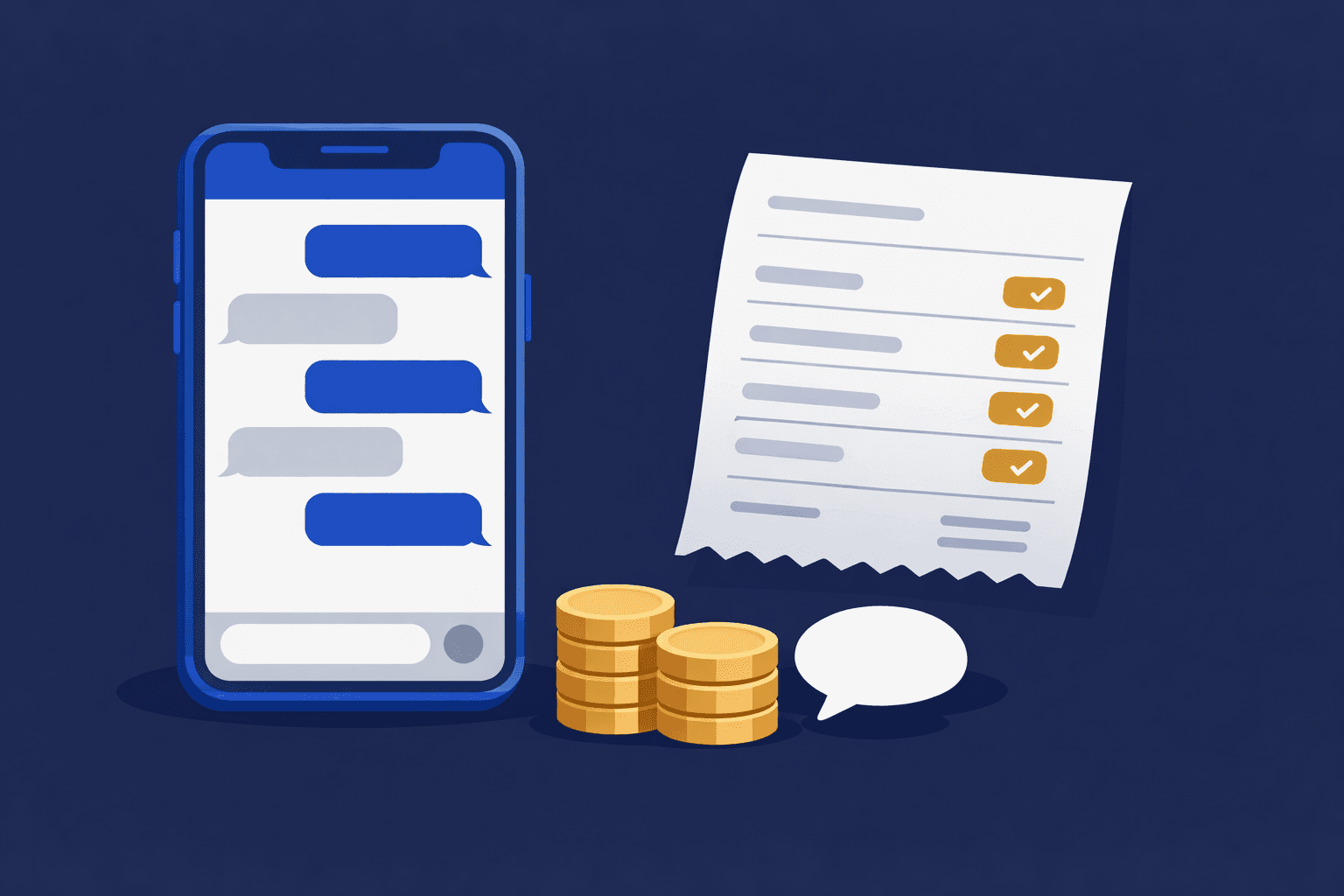
A credit is a unit of billing capacity, not a unit of communication. The confusion is intentional, though not necessarily malicious. Platforms buy SMS throughput wholesale from carriers, and carrier pricing is based on message segments, not conversations. Platforms then translate segments into their own currency — credits — so they can set a margin and offer simple-sounding plans.
The result is a two-step conversion you're never shown directly:
- Your message is split into segments by the carrier based on character count and content type.
- Each segment maps to some number of credits based on your platform's internal rate.
Most platforms do not publish step two in plain language. You find out when you run low.
How Segments Work in Practice
A standard SMS segment holds 160 characters using GSM-7 encoding, which covers the basic Latin alphabet. Once you include a single character outside that set (a curly apostrophe, an emoji, a smart quote pasted from a document), the message switches to Unicode encoding and each segment shrinks to 70 characters. A 180-character reminder with one emoji is now three segments, not two.
MMS works differently. Any message with an image, GIF, or video is billed as MMS regardless of length. Carriers charge more for MMS throughput, and platforms pass that through. A single "thanks for booking" text with your logo attached can cost four times as much as the same message without the image.
Practical examples:
- A clean 140-character reminder in plain text: one segment, one credit.
- A 300-character reminder with a service description and a booking link: two segments, two credits (or more, depending on your platform's rate).
- A 90-character message with one emoji: two segments at Unicode encoding.
- Any image message: typically 3-5 credits, platform-dependent.
If your platform charges 1 credit per segment, the math is straightforward. Many charge 1.5 or 2 credits per segment at higher volume tiers, which is where the forecasting gets genuinely difficult.
Why Platforms Prefer Credits to Transparent Per-Message Pricing
A credits model benefits the platform in two ways. First, it smooths out the carrier cost variability so the platform can offer a clean monthly plan without absorbing carrier price fluctuations. Second, it obscures the real per-message cost so it's harder for you to comparison-shop.
This isn't unique to salon software. Most SaaS tools that bundle communication into their pricing do the same thing. The problem is that appointment businesses are high-volume SMS users by nature. Reminder strategies that actually change client behavior often require multiple touches per appointment — confirmation at booking, a reminder at 72 hours, a final nudge at 24 hours. Three messages per appointment, across 30 appointments a week, is 90 messages minimum before you account for cancellation notices, rescheduling, or marketing blasts.
At that volume, a difference of 0.5 credits per message is real money every month.
What to Ask Any Platform Before You Buy
Before committing to any messaging tier, get answers to these four questions in writing:
- What is the character limit for a single-credit SMS? Ask for the exact number, not "standard segment size."
- How does your platform handle Unicode characters and emoji? Does it automatically split or does it warn you before sending?
- What is the credit multiplier for MMS messages?
- Do credits roll over, and what happens to unused credits at month end?
That last one matters more than most owners realize. A plan that sounds generous at 2,000 credits per month means nothing if unused credits expire. You end up buying more than you send just to stay ahead of the rollover cliff.
If a platform can't answer these questions clearly, treat that as useful data about how they handle billing transparency in general. The comparison of appointment business platforms can help you see how pricing structures differ across the tools most salons and spas are already considering.
How to Estimate Your Actual Monthly SMS Volume
Start with your appointment count, not your plan's credit limit. Here's the arithmetic:
- Take your weekly appointment count and multiply by 4.3 for a monthly figure.
- Multiply by the number of automated messages you send per appointment (confirmation plus reminders is typically 2-3).
- Add 15% for cancellations, rescheduling messages, and replies.
- Check your average message length. If any include emoji or exceed 160 characters, multiply that portion by 2.
That number is your baseline segment count. Then apply your platform's credit conversion rate to get expected monthly credits. Compare that to your current plan. Most operators who run this math find they're either over-buying or consistently triggering overage fees because their estimates were based on the plan name, not the actual volume.
For businesses managing no-shows through automated confirmation calls and texts, the volume is even higher because every at-risk appointment generates additional outbound messages.
What Good Billing Transparency Looks Like
A few platforms have moved toward per-message pricing with explicit segment disclosure, though they're still the minority. What you want to see is:
- A usage dashboard that shows segments sent, not just credits consumed
- A message preview tool that warns you when a draft will trigger multi-segment billing
- Separate line items for SMS and MMS on your invoice
- Clear documentation of what happens at overage (pay-per-credit vs. service suspension)
Mindbody and Vagaro both use credit-based models, and both have faced operator complaints about billing predictability. Boulevard's approach is more transparent at the segment level, though it varies by plan tier. Regardless of which platform you're on, the solution is the same: run your own volume math before trusting the plan's headline credit count.
Tersavia publishes its messaging costs without a credits layer, which means you can see the per-message rate directly. Whether or not that matters to your decision, it's the standard worth demanding.
FAQ
What is the difference between an SMS credit and an SMS message?
An SMS credit is a platform billing unit. One message may consume one, two, or more credits depending on its character count, encoding, and content type. Platforms set their own credit conversion rates, which are often not published clearly.
Why does an emoji cost more credits to send?
Emoji trigger Unicode encoding, which reduces the characters per segment from 160 to 70. A message that would be one segment in plain text can become two or three segments with a single emoji, each of which consumes credits.
Do unused SMS credits carry over to the next month?
This depends entirely on the platform. Many plans expire unused credits at month end. Before purchasing any messaging tier, confirm the rollover policy in writing.
How many SMS messages does a typical salon or spa send per month?
A business running 120 appointments per week and sending two automated messages per appointment sends roughly 1,000 messages per month before accounting for marketing, cancellations, or rescheduling. At multi-segment rates, that translates to 1,500-2,000 credits or more depending on message length and platform conversion rates.