What AI Does With Every Call Your Front Desk Takes
How voice AI records, transcribes, and summarizes every call at an appointment business — so nothing falls through the cracks at the front desk.
TL;DR: When voice AI handles a call, it doesn't just answer and hang up. It records the conversation, generates a timestamped transcript, and produces a plain-English summary that your team can read in seconds. Nothing gets lost between the call and the calendar.
Front desk staff at busy salons and spas are always managing two things at once. A client is standing at the counter being checked out, a card is being run, and the phone rings. Someone has to decide: finish the checkout or answer the call. Most of the time, the call goes to voicemail. And most voicemails never turn into booked appointments.
Voice AI solves the answer problem. But what many operators miss is what happens *after* the call ends. The recording, the transcript, the summary — that's where the operational value lives. This post walks through one scenario from start to finish: a caller contacts a med spa, voice AI handles the full conversation, and the team picks up a complete record the moment they're free.
The Call Comes In Mid-Checkout
It's a Tuesday afternoon. A provider is finishing a hydrafacial. The front desk associate is processing the client's payment, reviewing retail add-ons, and asking about the next appointment. The phone rings.
Voice AI picks up before the second ring. The caller is a new client. She found the business through Google, wants to ask about a laser hair removal package, and has a few questions about pricing and how many sessions she'd need. She's also asking for the soonest available appointment.
This is a multi-part call. It's not just a "book me on Thursday" request. It involves service education, pricing discussion, scheduling, and — if the conversation goes well — capturing contact information and a deposit. A voicemail would have dropped most of that context entirely.
Voice AI works through each part of the conversation. It answers the package question using the information it's been given about services. It shares pricing at the level the operator has configured. It checks availability and offers two open slots. The caller picks one, provides her name and number, and the call ends. Total call time: four minutes and eighteen seconds.
What Gets Captured After the Call Ends
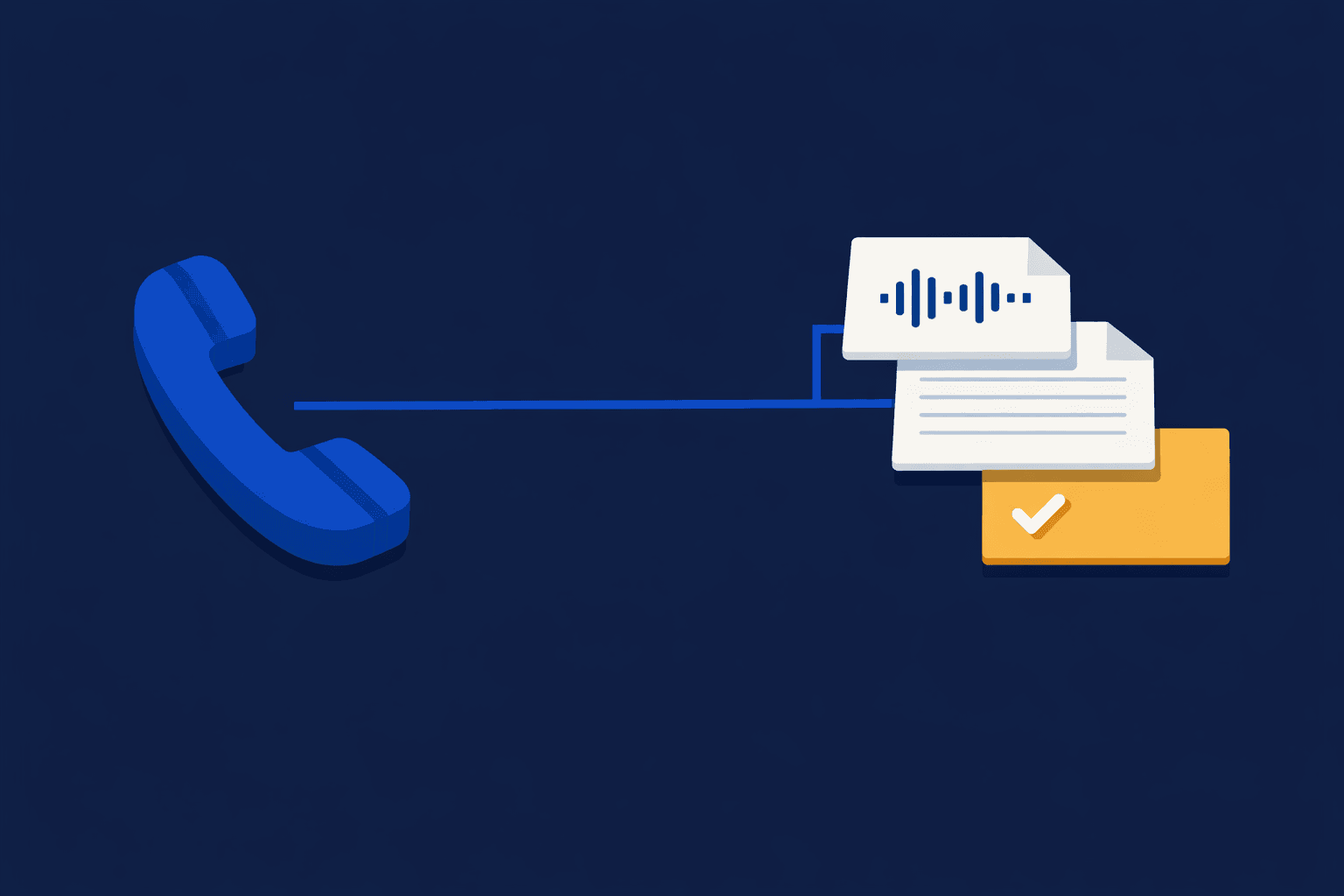
This is where the scenario gets specific. The moment the call ends, three things happen automatically.
Recording. The full audio of the call is stored and accessible from the call log. The operator or manager can play it back at any time. This matters for quality control, staff training, and any dispute about what was said (especially relevant in med spas where pricing and contraindication conversations happen over the phone).
Transcript. A timestamped, speaker-labeled transcript is generated from the audio. It reads like a script: caller's words on one side, AI's responses on the other, with timestamps at each turn. This is searchable. If a client calls back two weeks later and says "the person I spoke with told me I'd only need four sessions," the transcript either confirms or contradicts that claim in under a minute.
AI summary. This is the piece that changes how fast a team can act. Instead of reading a four-minute transcript, the front desk associate sees something like this:
- Caller: Sarah M., new client, referred by Google search
- Inquiry: laser hair removal package pricing and session count
- Information shared: six-session package, pricing as configured, standard session spacing
- Outcome: appointment booked, Thursday at 2:00 PM
- Follow-up needed: send pre-care instructions before the appointment
A team member who was tied up at the desk reads that in fifteen seconds. They know exactly who called, what was discussed, what was promised, and what still needs to happen.
Why the Summary Layer Is the Useful Part
Recordings are protective. Transcripts are accurate. Summaries are operational.
For a front desk associate coming off a checkout, a transcript is still a document to read. At a busy spa, nobody has time to read a four-minute conversation in full between clients. The summary pulls out what's actionable and presents it without noise.
For a manager reviewing calls at end of day, the summary layer allows a scan of everything that came in. They can spot patterns — three callers in one afternoon asking about a service the website doesn't explain well, or a recurring question about cancellation policy that could be answered on a FAQ page — without listening to hours of audio.
For training, the combination of all three (audio, transcript, and summary) is more useful than any one format alone. A new hire can listen to how a call flowed, read the exact words used, and then compare to the AI's interpretation of the outcome. That's a real training loop.
Operators who track call-to-booking conversion rates already understand that a missed call is rarely just a missed call. It's a missed booking, a missed deposit, and often a missed long-term client. The summary layer makes it easier to close those gaps because the team actually knows what happened.
What Happens to Calls That Don't Book
Not every call ends in a confirmed appointment. A caller might not be ready to commit, might ask for a price the operator hasn't enabled the AI to share, or might have a question that requires a human answer. When those calls happen, the summary is especially useful.
If voice AI reaches its configured limit and offers to have someone call the caller back, that handoff note lives in the summary. The front desk associate doesn't need to listen to the call to know what the caller wanted and where the conversation stopped. They pick up with context.
For callers who asked questions but didn't book, the summary gives the team a follow-up target. That caller's name, number, and inquiry are in the log. A staff member can return the call informed, not cold. This is the difference between a follow-up that feels personal and one that starts with "How can I help you?" when the caller already explained themselves once.
If your front desk is already dealing with high phone volume that strains operations, having a structured call log with summaries means the backlog is manageable. You're not triaging voicemails — you're reading a clean list of what came in and what each call needs next.
How This Looks in Practice for Different Business Types
The scenario above is a med spa, but the same call-to-summary flow applies across appointment businesses:
- A salon caller asking about a new stylist's availability, pricing, and color services leaves a four-part inquiry. The summary flags all four, and the front desk associate books knowing exactly what the client expects.
- A massage therapy client calling to reschedule has a preference for a specific provider and a time window. The summary captures both so the team doesn't rebook the wrong provider and have to call back.
- A barbershop with multiple locations gets calls for the wrong location. The summary notes the confusion so the owner can evaluate whether the website is directing people correctly.
None of this requires a staff member to be on the phone. It requires a voice AI layer and a system that stores, transcribes, and summarizes what it handles. Tersavia's AI reception platform does exactly that — every call gets a recording, a transcript, and a summary the team can act on.
For businesses that have already dealt with the cost of missed calls, the recording and summary system is what turns "we never miss a call now" into "we know exactly what every caller wanted and what happened next."
FAQ
Can AI-generated call summaries replace listening to the recording?
For day-to-day operations, the summary handles most situations — it captures caller intent, what was discussed, and what follow-up is needed. The recording is there when you need verbatim accuracy: a pricing dispute, a training review, or a situation where the summary's interpretation matters less than the exact words.
What happens if the AI can't answer a caller's question?
Voice AI is configured with a transfer or callback threshold. If a call goes outside what it's set up to handle, it routes to a staff member or logs a callback request. Either way, the transcript and summary capture everything up to that point so the handoff has context.
How long are call recordings and transcripts stored?
Storage duration depends on the platform's configuration. For operational use, most businesses review call logs daily or weekly. Recordings are most useful for quality review within the first few days; transcripts have longer-term value for dispute resolution and training.
Do callers know they're being recorded?
Voice AI systems that record calls are configured to play a disclosure at the start of the call, consistent with applicable recording laws. The operator controls the disclosure message and should consult their state's requirements, since one-party and two-party consent rules vary by location.