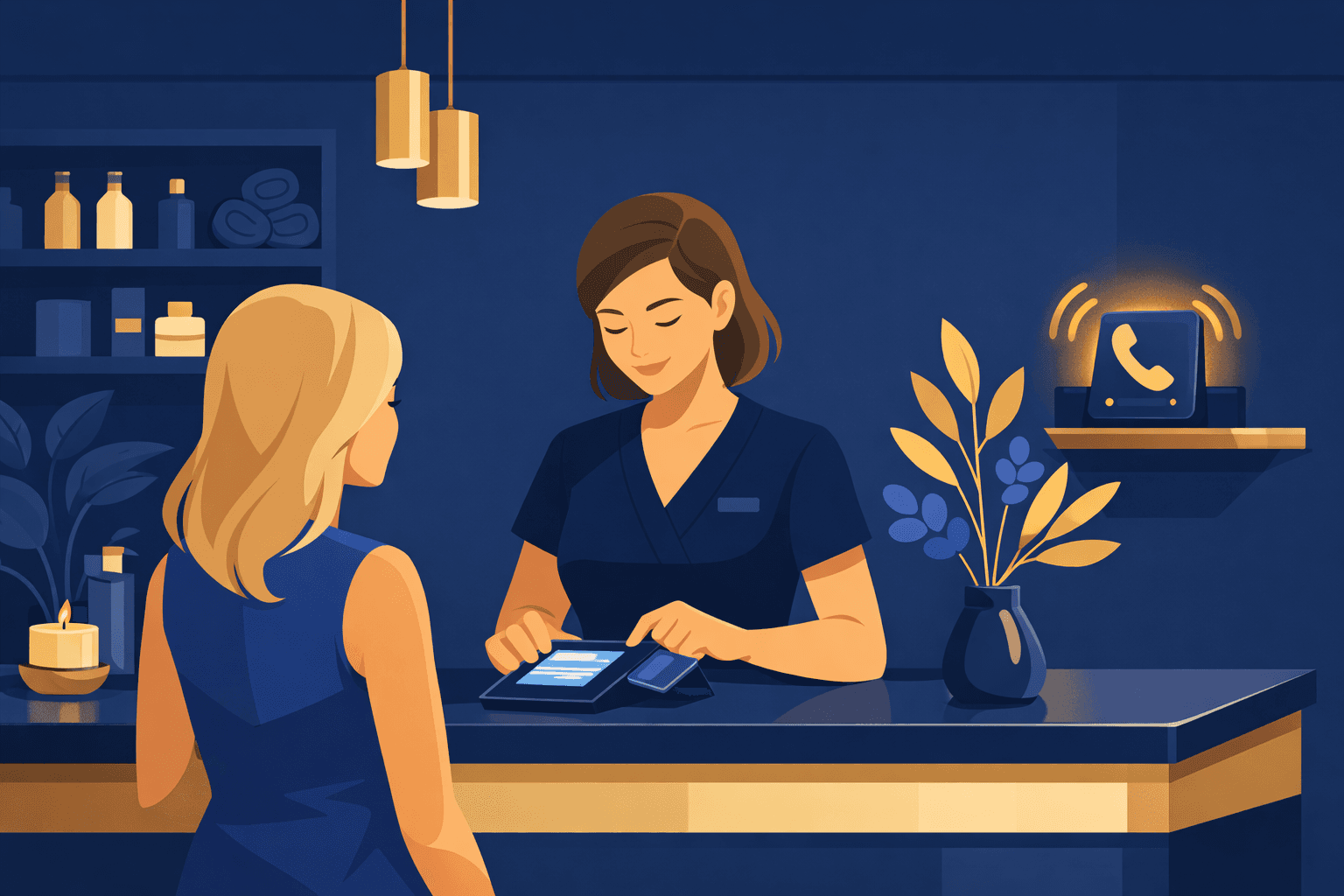
Phones Ring While You're Checking Someone Out
Learn how voice AI handles front desk phone volume when your receptionist is mid-checkout — so no call drops and no client waits.
TL;DR: When your front desk is mid-checkout, every call that rings unanswered either goes to voicemail and dies there, or pulls your receptionist away from the client standing in front of them. Voice AI picks up that call instantly, books the appointment, and sends a confirmation — without interrupting the checkout already in progress.
It happens dozens of times a day at busy salons, spas, and med spas. A client is at the desk settling a bill, picking a retail product, maybe rescheduling before they leave. The phone rings. Your receptionist glances at it, glances at the client, and has to make a split-second call about which one matters more.
Both matter. That's the problem.
The client checking out is already yours. They came in, they got the service, they're happy. But the person calling? They're new, or they've been meaning to rebook for months, or they finally got a referral from a friend and picked up the phone on impulse. If that call hits voicemail, research from multiple booking software providers consistently puts the callback conversion rate well below 50%. The moment is gone.
What Actually Happens Without Coverage
The checkout scenario is worth walking through precisely, because the failure isn't dramatic — it's quiet and repetitive.
Your receptionist is processing a $180 payment. The phone rings. Three options:
- They let it ring and it goes to voicemail. The caller may or may not leave a message. If they do, the receptionist calls back later when the caller is busy, unavailable, or already booked somewhere else.
- They answer mid-checkout, put the caller on hold, and split attention between two conversations. The checked-out client feels rushed. The caller hears hold music and hangs up after 90 seconds.
- They hand off the checkout to another staff member, which only works if there's another staff member free.
None of these outcomes are good for revenue. None of them are good for the client experience on either end of the transaction. And the cost of a missed call compounds when it's happening at your peak hours — which is exactly when checkouts and inbound calls stack on top of each other.
How Voice AI Steps In at That Moment
Voice AI doesn't replace your receptionist. It covers the phone during the moments your receptionist physically cannot.
Here's what the same scenario looks like with voice AI in place:
The phone rings while your receptionist is mid-checkout. The AI answers on the first or second ring, greets the caller with your business name, and immediately moves into the booking flow. It asks what service they're looking for, what day and time works, and whether they've been in before.
The caller books, gets a confirmation text, and hangs up in under three minutes. The receptionist finishes the checkout without interruption. The client at the desk had a clean, unhurried experience. The caller got a booked appointment instead of a voicemail.
Neither person knew the other existed. That's the point.
For businesses running on Vagaro, Mindbody, or Boulevard, Tersavia's AI reception layer sits in front of your existing system — the appointment lands directly on the right provider's schedule, in the right time slot, without anyone touching the keyboard.
The Peak Hours Problem Is Structural
Front desk phone pressure isn't random. It clusters. Morning rushes. Lunch windows. The 5–7 PM block when people are done with work and thinking about self-care.
Those are also the hours when your chairs are fullest, your checkout line is longest, and your staff is most stretched. The phones don't slow down when you're busy — they speed up, because busy hours are when people walk past your storefront, see your Google listing, or get a text reminder from a friend who was just in.
A single receptionist handling checkout, rebooking, retail, and inbound calls during peak hours is going to drop something. It's a capacity problem, not a performance problem. No amount of hiring can solve it cost-effectively if the solution is adding a full-time person just to catch overflow calls.
Voice AI handles that overflow without a seat, a schedule, or a payroll line. It covers simultaneous calls, too — if three people call at once during a Saturday morning rush, all three get answered.
What the AI Can and Cannot Handle
Being clear about this matters, because overpromising on AI capabilities does nobody any favors.
Voice AI handles well:
- Booking new appointments, including collecting service preference, provider preference, and date/time
- Rescheduling existing appointments when the caller provides their name or phone number
- Answering standard questions about hours, location, and services offered
- Taking a message and flagging it for follow-up when the request falls outside its scope
- Sending confirmation texts immediately after booking
Voice AI hands off to a human:
- Complaints or upset callers who need empathy and discretion
- Medical history questions at a med spa that require clinical judgment
- Anything involving a refund dispute or a billing disagreement
- Requests that fall outside the booking flow and require judgment calls
Knowing when the AI should transfer a call to a human is as important as knowing what it can handle on its own. A well-configured system flags those handoff moments and routes them properly instead of getting stuck in a loop.
What This Means for Front Desk Morale
This is an underrated piece of the conversation. Receptionists at busy salons and spas are doing genuinely hard work: they're customer-facing, they're managing scheduling complexity, and they're absorbing the stress of a packed floor. Adding constant phone pressure on top of that is a fast track to burnout and turnover.
When voice AI absorbs the overflow, your receptionist can give full attention to the client in front of them. Checkout conversations improve. Retail recommendations land better because there's time to make them. Rebooking happens more naturally because nobody's rushing.
That's not a soft benefit. Checkout is one of the highest-leverage moments for rebooking, upselling, and retention. Voicemail costing you bookings is one side of this problem — the other side is a distracted checkout costing you the rebooking conversation you could have had with the client already standing there.
FAQ
Q: Will callers know they're talking to an AI?
A: Most voice AI systems disclose this at the start of the call or when asked directly. The more relevant question is whether the caller gets their appointment booked — most do, and most don't care how it happened as long as it was quick and accurate.
Q: What if the caller wants a specific provider but that provider is fully booked?
A: A properly configured voice AI offers the next available time for that provider, or offers an alternative provider with availability. It doesn't book into a slot that isn't there. Exactly how this is configured depends on how your system is set up.
Q: Does voice AI work during after-hours calls too, or just during the day?
A: Voice AI runs continuously — it doesn't clock out. The same coverage that handles a checkout-time overlap at 2 PM also captures a call at 9 PM when the business is closed. Both scenarios result in a booked appointment rather than a voicemail.
Q: How does voice AI know the current schedule?
A: It connects to your booking system in real time. For businesses on Vagaro, Mindbody, or Boulevard, the AI reads live availability and writes confirmed appointments directly to the calendar — no manual entry required on your end.