Review Timing: Ask When Clients Are Still Glowing
Ask at the wrong moment and clients ignore you. This guide shows small businesses exactly when to request Google reviews for maximum response rates.
TL;DR: Most businesses lose reviews not because clients are unwilling — but because they ask at the wrong moment. Timing your review request to the emotional peak of the client experience can double or triple your response rate without changing a single word of your ask.
You did everything right. The service was excellent, the client left happy, and you even sent a follow-up message. But your review count hasn't moved in weeks.
Here's the uncomfortable truth: it probably isn't your request — it's your timing.
Review requests are a lot like asking someone how they feel about a meal. Ask while they're still at the table, still savoring it, and you'll get an enthusiastic answer. Ask three days later when they're halfway through something else and you'll get a polite shrug. The window of peak satisfaction in a service business is short — often less than 90 minutes after checkout — and most businesses systematically miss it.
This post is about closing that gap. Not with scripts or tricks, but with a clear-eyed look at when the emotional conditions are right for a client to say something genuinely positive — and how to build a request cadence around that reality.
Why Timing Beats Wording Every Time
There's an entire industry of "perfect review request scripts" online. Most of them are fine. None of them matter much if the timing is off.
Research on customer satisfaction consistently shows that emotional recall decays fast. A client who just stepped out of a facial feeling relaxed and refreshed is experiencing a genuine emotional high. That same client 48 hours later is back in her inbox, juggling her week, and the experience — however wonderful — has faded into the background noise of daily life.
This isn't a criticism of your clients. It's just how human memory works. Positive emotions are vivid in the moment and fade faster than negative ones. (Negative experiences tend to linger — which is exactly why unhappy clients find the time to leave reviews unprompted.)
The practical implication: your happiest clients will write reviews, but only if you catch them while the experience is still alive in their minds.
The businesses with 200+ Google reviews aren't necessarily better than the ones with 30. They've just built their ask into a moment when clients are still in the glow.
The Three Windows (And What Each One Gets You)
There are three distinct timing windows for a review request. Each has a different response rate and a different practical approach.
Window 1: In the Chair / At Checkout (0–15 Minutes Post-Service)
This is the highest-emotion moment, but it carries real risks if handled clumsily. A direct ask at checkout can feel transactional — like you care more about the review than the relationship.
Done right, though, it's powerful. The key is warmth over mechanics:
- A front-desk team member mentions it conversationally, not as a script
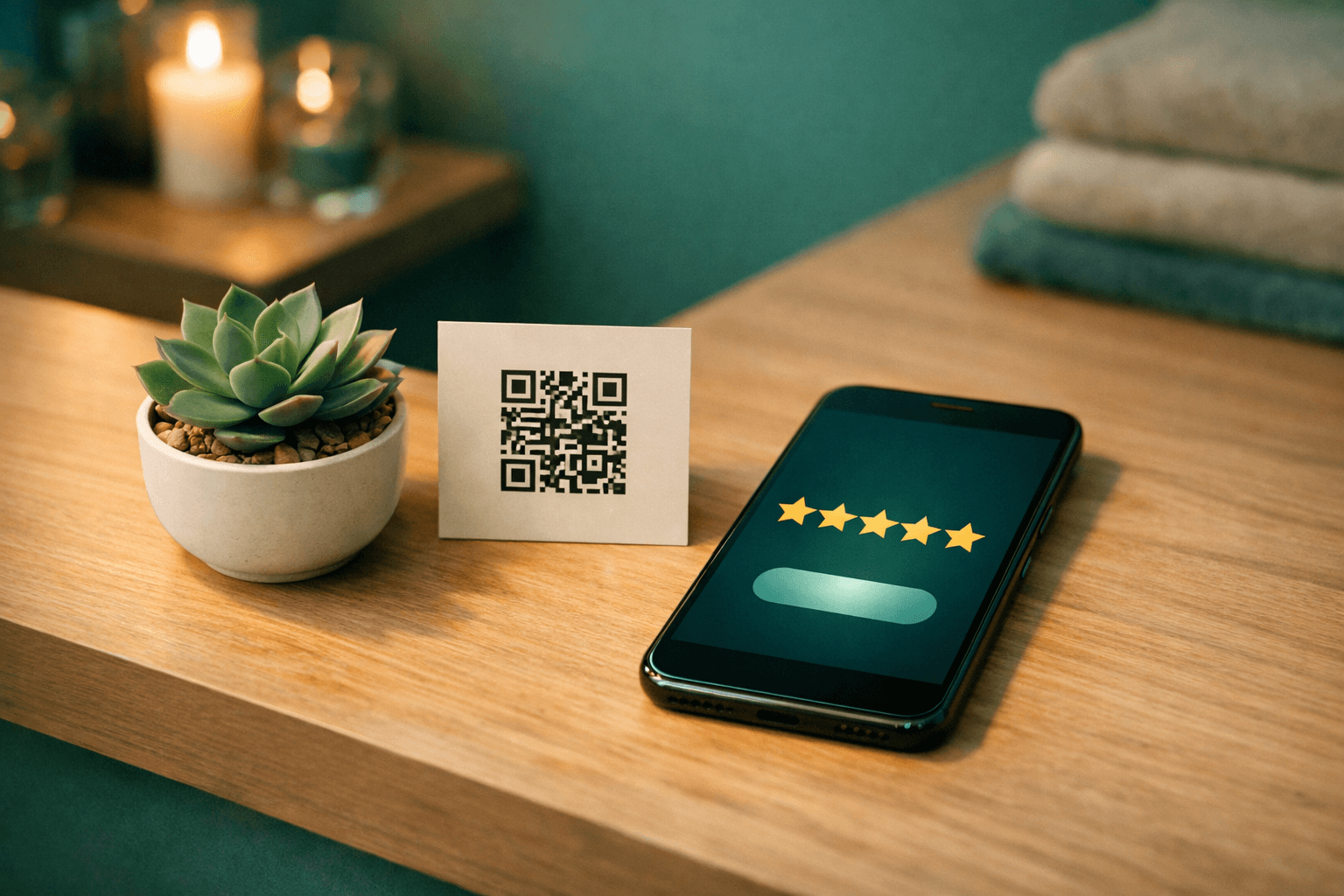
- A QR code is visible on the checkout counter with a low-pressure label like *"Loved your visit? We'd be grateful for a Google review"
- The stylist or esthetician mentions it personally: *"If you have a moment, a Google review really helps us — it only takes two minutes"
Expected response rate: 15–25% when done in person by the provider
Best for: High-rapport services (hair, massage, esthetics) where the provider relationship is strong
Window 2: The 30–90 Minute Follow-Up
This is the sweet spot most businesses miss. Your client is still in the post-service afterglow — hair feels great, they're probably glancing in a mirror, maybe they've already posted to Instagram — but they're not yet back in full work mode.
An SMS or automated message sent 30–90 minutes after checkout hits this window reliably. It feels timely without feeling like surveillance. A simple structure that works:
*"Hope you're loving your [service] — it was great to see you today. If you have two minutes, a Google review means the world to small businesses like ours. Here's the link: [direct review URL]"*
Keep it personal, keep it short, make the link frictionless (a direct Google review link, not your homepage).
Expected response rate: 20–35% for satisfied clients who just had a strong experience
Best for: Any business with a post-service SMS workflow — this is where most of the volume comes from
Window 3: The 24–48 Hour Reminder
If a client didn't respond in Window 2, a single follow-up at 24–48 hours is appropriate. Not every client acts immediately, and some genuinely need a gentle nudge.
This reminder should be lighter in tone — acknowledging that they're busy, making the ask feel easy:
*"We know you're busy — just a quick reminder that a Google review takes about 90 seconds and really helps us out. No pressure, but we'd love to hear your thoughts."*
Send one follow-up. Not two. Not a weekly drip. One.
Expected response rate: 8–15% incremental lift on top of Window 2
Best for: Clients who opened your first message but didn't click, or higher-ticket services where the relationship warrants a second touch
What Kills Timing (Even When Everything Else Is Right)
A few common mistakes that erode your timing advantage:
Batching your requests at end of day. Some booking systems send review prompts on a nightly batch schedule. By the time your 9am client gets a review request at 6pm, the emotional window has closed by hours. If your CRM — whether it's Vagaro, Mindbody, Mangomint, or Boulevard — supports custom trigger timing, set it to fire 45–60 minutes post-appointment, not end of day.
Sending to a cold list. Blasting review requests to your entire client database is not timing strategy — it's noise. It trains clients to ignore your messages and dilutes the impact of a well-timed ask to genuinely fresh experiences.
Burying the link. If a client has to navigate to your website, find your Google listing, and then click through to leave a review, most of them won't bother. Generate a direct Google review link from your Google Business Profile and use it everywhere. The fewer taps between your message and the review box, the better.
Making the ask about you. *"We need reviews to grow our business"* is true but it's the wrong frame. *"We'd love to hear your feedback"* or *"Your experience matters to us"* centers the client — which is where the framing belongs.
Building a Simple Review Timing System
You don't need expensive software to get this right. Here's a straightforward system that works for most service businesses:
- Set a post-appointment SMS trigger in your booking system for 45–60 minutes after checkout. Most platforms support this natively.
- Write one message (under 60 words, direct review link, personal tone). Don't overthink it.
- Add a single 24-hour follow-up for clients who didn't click — segment this if your platform allows it.
- Put a QR code at checkout as a passive, in-person reinforcement layer.
- Train your team on a one-sentence verbal mention during checkout — not a script, just a natural mention.
- Review your timing monthly. Check whether your requests are actually going out at the right time, not in a batch at midnight.
For businesses handling a high call volume or running lean on front-desk staff, tools like Tersavia can trigger post-appointment messages automatically as part of the call and booking workflow — so the timing is built in rather than dependent on someone remembering to send it.
A Note on Volume vs. Velocity
One thing that trips up a lot of owners: focusing on the total review count when you should be watching velocity — how frequently new reviews are coming in.
Google's algorithm weighs recency heavily. A business with 40 reviews posted in the last six months will often outrank one with 180 reviews where the last one was eight months ago. This means a consistent, well-timed ask cadence is more valuable than a one-time push.
Aim for a pace that's sustainable: 5–10 new reviews per month for a single location is strong. That's achievable with a reliable 45-minute trigger and a one-sentence checkout mention. You don't need a campaign — you need a habit.
Conclusion
The businesses racking up Google reviews at a steady clip aren't doing anything exotic. They've just stopped treating the review ask as an afterthought and started treating timing as the strategic lever it actually is.
Catch clients in the right window — while the experience is still warm — and your ask barely needs to do any work. Miss the window, and the most persuasive script in the world won't save you.
Build the timing into your workflow, make the link frictionless, keep the ask human, and repeat it consistently. That's the whole strategy.
FAQ
Q: How soon after an appointment should I send a review request?
A: The 30–90 minute window after checkout is the most effective for most service businesses. Clients are still in the post-service glow but back on their phones. Requests sent 24+ hours later see significantly lower response rates.
Q: Should I ask for a review in person or by text?
A: Both — they work as a stack, not an either/or. A warm verbal mention at checkout + a direct SMS link 45–60 minutes later consistently outperforms either approach alone. The in-person ask primes the client; the text provides the frictionless path to act.
Q: How many times should I follow up if a client doesn't leave a review?
A: Once. Send an initial message at 30–90 minutes post-checkout, then one follow-up at 24–48 hours for non-responders. More than that crosses into pressure, which damages the relationship and rarely produces the review anyway.
Q: Does review recency matter more than total review count for local SEO?
A: Yes — Google weights recency heavily in local rankings. A steady stream of fresh reviews (even at lower volume) is more valuable than a large but stale review count. Aim for consistency over bursts.