Google Ads Budget & Local Targeting for Salons
Learn how salons and spas can set Google Ads budgets, target local intent, and turn ad clicks into booked appointments — not wasted spend.
TL;DR: Google Ads can drive real, bookable clients to your salon or spa — but only if your budget is set correctly and your targeting is tight. This post covers how to build a local-intent campaign from scratch, what to spend, and how to make sure every click has a chance to convert.
There's a version of Google Ads that works incredibly well for appointment-based businesses. There's also a version that quietly drains $800 a month while booking you nothing.
The difference isn't luck. It's not even budget size. It's whether your campaign is built around local intent — the specific moment when someone in your area is actively searching for what you offer, ready to book.
Salons, spas, med spas, barbershops, and wellness clinics all operate in a hyperlocal world. Your client base lives within five to fifteen miles of your front door. Google Ads can put you directly in front of those people at exactly the right moment — but the platform defaults aren't designed for that. Out of the box, Google will happily spend your money showing ads to people across your entire metro area, or worse, to people who aren't remotely ready to book.
Here's how to build it the right way.
What "Local Intent" Actually Means (and Why It Matters)
Local intent is the signal embedded in a search query that tells you the person wants something nearby, right now or very soon. Searches like:
- *"facial near me"*
- *"blow dry bar open Saturday Austin"*
- *"best massage spa [neighborhood name]"*
- *"laser hair removal consultation [city]"*
These aren't curiosity searches. They're pre-booking searches. The person typing that query is usually within one or two steps of calling a business or hitting a booking button.
Contrast that with broader searches like *"how much does a facial cost"* or *"types of hair extensions."* Those are research queries. They might eventually convert, but they'll burn through budget fast if you're bidding on them without filters.
Building a Google Ads campaign for a salon or spa means prioritizing local-intent keywords relentlessly. Every other optimization flows from that decision.
Setting a Realistic Budget
One of the most common mistakes appointment businesses make with Google Ads is starting with a budget that's too small to generate enough data — then quitting before the campaign has a chance to work.
Here's a practical framework:
Minimum Viable Budget
For most mid-size markets (cities with 150,000–500,000 people), a minimum effective budget is $600–$900/month for a single-service campaign. Below that, you're likely to run out of daily budget by noon and miss afternoon and evening searchers entirely.
In larger metro markets — Los Angeles, New York, Chicago, Miami — that floor climbs to $1,200–$1,800/month just to stay visible.
Budget-to-Revenue Math
Before you set a number, do this quick calculation:
- Average appointment value: What does a new client spend on their first visit? (Example: $120 for a cut + color)
- Close rate: Of every 10 people who call or visit your booking page from an ad, how many actually book? (Industry average: 30–50%)
- Cost per click (CPC): Local service searches for salons and spas typically run $2.50–$6.00 per click depending on market and service type. Med spa and laser services skew higher — sometimes $8–$15.
Example math: If you're paying $4/click, need 10 clicks to get one booking, and that booking is worth $120, your cost-per-acquisition is $40 — leaving $80 in gross margin before factoring in lifetime value. That's a workable number.
If your close rate is lower or your CPC is higher, the math shifts. Knowing your numbers upfront tells you whether Google Ads makes sense for a given service before you spend a dollar.
Allocate by Service, Not Business
Don't run one campaign for your entire menu. Set separate campaigns (or at minimum, separate ad groups) for your top two or three revenue-driving services. This lets you:
- Control spend per service
- Write specific ad copy that matches the search
- Send clicks to a service-specific landing page (more on this below)
- Track what's actually booking
Campaign Structure for Local Targeting
Google's default targeting settings are designed for broad reach. You need to override several of them.
Geographic Targeting: Tighter Than You Think
Set your location targeting to a radius around your business address — not city-wide, not zip-code-wide. For urban areas, 5–8 miles is usually right. For suburban markets, 8–12 miles.
Critically, go into Location Options and set targeting to *"People in or regularly in your targeted locations."* The default includes people who *show interest in* your locations — which pulls in people researching your city from across the country. Turn that off.
Keyword Match Types: Mostly Phrase, Some Exact
For local-intent campaigns, use a mix of:
- Phrase match for queries like *"[service] near me"* or *"[service] [city]"*
- Exact match for your highest-converting, clearest intent terms
Avoid broad match until you have significant conversion data. It burns budget on irrelevant queries faster than almost anything else.
Negative Keywords: Non-Negotiable
Build a negative keyword list from day one. Common negatives for salons and spas:
- free, DIY, how to, tutorial, school, training, certification, near you (if you're excluding certain areas), cheap (depending on your positioning), reviews (informational, not transactional)
Check your Search Terms report weekly for the first month and add negatives aggressively. This is the single fastest way to stop wasted spend.
Ad Scheduling
Run ads during hours when your phones are answered and your booking page is live. If you're closed Sunday and Monday, pause ads those days or cut bids significantly. Paying for clicks when no one can book — or worse, when the phone rings to voicemail — is money out the window.
If you've solved your after-hours call handling (for example, with an AI receptionist that can book appointments around the clock), you have more flexibility to run ads evenings and weekends. That's a real competitive edge — your competitors' ads are driving calls to voicemail at 8pm. Yours are driving calls to a live booking experience.
Writing Ads That Attract Bookers, Not Browsers
Your ad copy needs to signal two things immediately: *you're local* and *you're ready for them right now.*
Strong elements to include:
- City or neighborhood name in the headline when possible
- Specific service (not just "spa services" — say "Deep Tissue Massage" or "Keratin Treatment")
- Availability cue — "Book Online Today," "Same-Week Appointments Available"
- A reason to pick you — years in business, award, specialty, unique differentiator
Use all available ad extensions:
- Call extensions: Your phone number, click-to-call. Critical for mobile searchers.
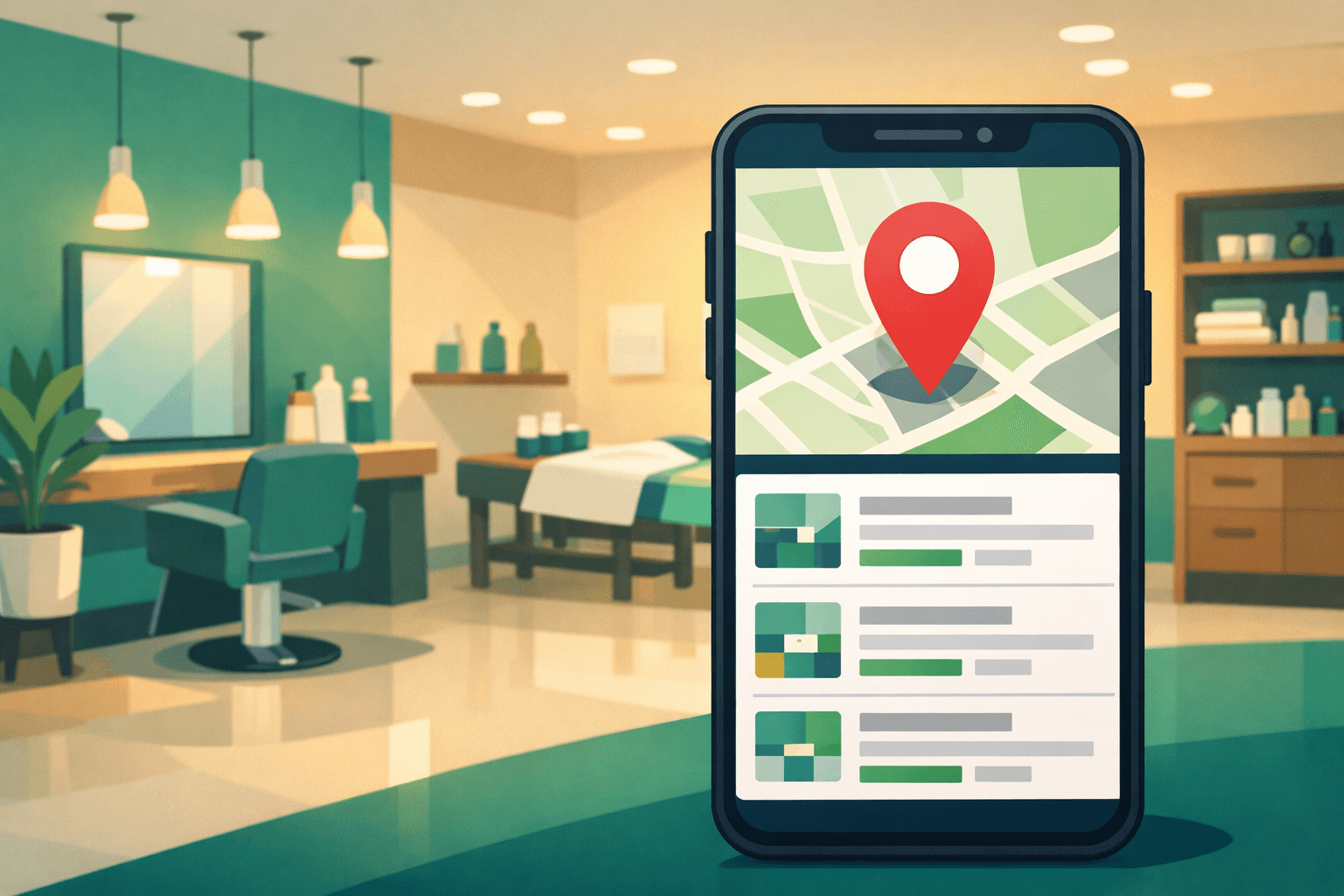
- Location extensions: Pulls your address and distance from the searcher.
- Sitelink extensions: Link directly to your booking page, your top service pages, and your pricing page.
- Callout extensions: Short trust signals — "No Deposits Required," "Online Booking Available 24/7," "5-Star Rated on Google"
Where Clicks Go (and Why Most Campaigns Fail Here)
You can do everything above perfectly and still waste your budget if you send clicks to the wrong destination.
Don't send paid traffic to your homepage. Your homepage is designed for exploration. Paid traffic should land on a page with one job: get this specific person to book this specific service.
A service-specific landing page should include:
- The service name in the headline
- 2–3 sentences on what the service includes
- Price or price range (this filters out mismatched traffic before they waste a booking slot)
- Real photos of your space and results
- A clear, prominent booking button or phone number
- One or two short reviews relevant to that service
- No navigation menu (remove the escape routes)
If you're using Vagaro, Boulevard, Mindbody, or Mangomint, your booking widget can often be embedded directly on this page. Use it. Every extra step between ad click and confirmed appointment is a drop-off point.
Tracking What's Actually Working
Google Ads without conversion tracking is guesswork. Set up:
- Google Ads conversion tracking for booking form completions or booking confirmation page views
- Call tracking — use a Google forwarding number or a third-party call tracking tool to tie phone calls back to specific campaigns and keywords
- Import data from your booking system — most major platforms (Vagaro, Mindbody, Boulevard) allow some form of revenue reporting that you can cross-reference with your ad data
At minimum, you want to know: which keywords are generating actual appointments, not just clicks. Without that data, you're optimizing for the wrong thing.
One often-overlooked piece: if a caller reaches voicemail instead of a live person or booking option, that conversion never happens — even if your ad targeting and copy were perfect. Platforms like Tersavia that handle calls and book appointments directly into your system make call tracking more meaningful, because more of those tracked calls turn into actual bookings.
Monthly Optimization Checklist
Once your campaign is live, set a recurring monthly review:
- Check Search Terms report — add new negatives
- Review geographic performance — pause underperforming zip codes
- Check device performance — mobile vs. desktop CPA
- Review ad scheduling — any hours with high spend and zero conversions?
- Check Quality Score on top keywords — low scores mean higher CPCs
- Rotate in a new ad variation if any existing ad has 500+ impressions with low CTR
- Confirm landing page is loading fast on mobile (use Google's PageSpeed Insights)
Frequently Asked Questions
Q: How much should a salon or spa spend on Google Ads per month?
A: In most mid-size markets, $600–$900/month is the minimum to generate enough data and visibility for a single service campaign. Larger markets and higher-CPC services like laser treatments or med spa procedures may require $1,200–$2,000/month to compete effectively. Start with one service, prove the math works, then scale.
Q: What's the difference between local intent targeting and standard Google Ads targeting?
A: Standard Google Ads defaults cast a wide geographic and keyword net. Local intent targeting tightens radius targeting around your physical location, filters for keywords that signal proximity and readiness to book, uses phrase and exact match types instead of broad match, and layers in negative keywords to eliminate research traffic. The result is fewer clicks, but a much higher percentage of those clicks turning into booked appointments.
Q: Should I use Google Ads or Google Local Services Ads (LSAs)?
A: These serve different purposes. LSAs appear above standard ads for specific service categories and work on a pay-per-lead model — you only pay when someone calls or messages through the ad. Standard Google Ads give you more control over messaging, landing pages, and targeting. Many salons and spas run both. If you're new to paid search, LSAs are lower-risk because you only pay for actual contacts, not clicks.
Q: What happens if someone calls from my Google Ad and hits voicemail?
A: That click is almost certainly lost revenue. The person searching right now has multiple options in front of them — if they reach voicemail, they'll call the next result. Ensuring every call from a paid campaign reaches a live answer point, whether human or AI, is one of the highest-ROI things you can do to improve your Google Ads performance.
The Bottom Line
Google Ads works for salons and spas when the campaign is built around one thing: the specific moment a nearby person is ready to book. That means tight radius targeting, local-intent keywords, service-specific landing pages, and tracking that connects ad spend to actual appointments.
The budget number matters less than the structure. A well-built $700/month campaign will outperform a sloppy $2,000/month campaign every time. Start small, prove the economics, and scale what's working.
And remember — the ad is only half the equation. What happens when that call comes in determines whether your ad spend turns into revenue or regret.