What a Front Desk Employee Actually Costs You
The real cost of a front desk employee goes beyond their hourly wage. Here's the full arithmetic for spas, salons, and appointment-based businesses.
TL;DR: A front desk employee's true cost is typically 1.25 to 1.4 times their base wage once you add payroll taxes, benefits, training time, and turnover. For a full-time hire at $18 an hour, that lands between $47,000 and $53,000 a year before you count what they can't cover.
Most spa and salon owners think about front desk labor as an hourly rate. That's the number on the job posting and the number on the timesheet, the figure that feels manageable. It is not the number on the P&L.
The loaded cost of a front desk hire is higher than the wage by a margin that surprises most operators the first time they build it out. It is also the wrong number to optimize. The real question is what you are buying for that cost, and whether the coverage actually matches the gaps you are trying to fill.
What You Pay on Top of the Wage
Every hour an employee works costs you more than the rate you agreed to in the interview. The additions are not optional and most of them are not visible until you run payroll.
Here is the standard stack on top of gross wages:
- Employer share of FICA (Social Security and Medicare): 7.65 percent of gross wages, up to the annual Social Security wage base
- Federal Unemployment Tax (FUTA): 6 percent on the first $7,000 of wages per year, though most employers pay far less after state credits
- State unemployment insurance (SUI): varies widely by state and by your claims history, commonly 1 to 3.5 percent for a newer account
- Workers' compensation insurance: rates depend on your state and job classification, but front desk roles in a spa or salon typically run between $1 and $3 per $100 of payroll
Add those together and you are paying roughly 10 to 15 percent above gross wages before you have offered a single benefit. For a full-time employee at $18 an hour, that is an additional $4,000 to $6,000 a year the wage line does not show.
If you offer health insurance, the employer contribution typically runs $300 to $600 a month for a single-employee plan. The final number depends heavily on the carrier and state, with the deductible structure pushing costs toward either end of that range. Dental and vision are smaller but add up. Paid time off is hours you pay for without revenue generated against them. A two-week PTO policy on an $18-an-hour full-time employee is roughly $1,440 of wages for time the desk is either unstaffed or covered by someone else.
The Hiring and Training Cost Nobody Budgets For
Turnover at the front desk is high. Nationally, hospitality and personal services see front desk turnover rates that can exceed 40 percent annually. That is not just inconvenient. It has a dollar cost.
Common estimates for the cost of replacing a non-managerial employee run between 50 and 75 percent of that employee's annual salary. For a front desk hire earning $37,000 to $40,000 a year, one replacement cycle costs you somewhere between $18,500 and $30,000 when you account for recruiting time, job posting fees, the hours your manager or owner spends interviewing, and the productivity gap during onboarding.
Training is slower than most owners expect. A new front desk employee at a spa or salon needs to learn:
- The booking software and its quirks
- Your service menu and pricing, plus the upsell logic behind it
- How to handle no-shows and late arrivals, and what your cancellation policy covers
- How to check clients out and process payments, including how deposits are handled
- How memberships and packages work and how to sell them conversationally
- Your communication preferences and tone with clients
A competent new hire is typically not fully independent for four to six weeks. During that window, a manager is covering gaps alongside a senior staff member, and that is their time diverted from other work.
The Coverage Math That Breaks Down at Scale
One full-time front desk employee covers approximately 40 hours a week. A typical spa or salon is open 50 to 60 hours a week. That means one hire does not cover the full operating week without overtime or a part-time second hire.
If you are open six days, and your single front desk employee works five, you are either:
- Pulling yourself or a service provider to cover the desk one day a week
- Hiring a part-time second person, bringing onboarding demands and ongoing coordination overhead
- Leaving calls and walk-ins unattended on the sixth day
None of those options are free. Option one takes a revenue-generating provider off the floor. Option two adds a second payroll line. Option three has a measurable cost too: a missed call in an appointment business is not a minor annoyance, it is a lost booking and often a lost client.
For multi-location operators, this scales hard. If you have two locations and each needs front desk coverage, you are not doubling a tidy number. You are doubling the entire loaded cost stack: wages, taxes, PTO, training, turnover, and the coverage gaps at both sites.
What the Desk Covers (and What It Doesn't)
The honest audit question is not "can I afford a front desk hire?" It is "what does the hire actually solve?"
A front desk employee handles:
- Greeting clients and checking them in
- Answering the phone during their shift
- Processing checkouts and collecting payment
- Booking and rescheduling in the software
- Handling basic questions about services and availability
What a front desk employee does not solve:
- Calls and booking requests that come in before or after their shift
- The phone that rings while they are checking someone out at the counter
- Late-night texts from clients who want to book for tomorrow morning
- Sick days and no-shows to their own shift, plus finding coverage for holidays
This is where the gap analysis matters. If your booking volume is high and your hours of operation are long, the hire is probably still necessary. But it is a hire with known blind spots, and those blind spots are often what drive operators to look at software that fills the off-hours without adding a second salary line.
The full arithmetic of your software costs sits alongside this calculation: a booking platform that charges per seat or per location is adding to the cost of every staff member you bring on, not just your desk hire.
Building the Real Number
Here is the loaded cost breakdown for a full-time front desk hire at $18 an hour in 2026:
- Base wages (2,080 hours): $37,440
- Employer FICA (7.65%): $2,864
- SUI and FUTA (estimated 3%): $1,123
- Workers' comp (estimated $2 per $100 payroll): $749
- PTO (10 days): $1,440
- Health insurance contribution (if offered, low estimate): $3,600
- Recruiting and onboarding cost, amortized over two years: $4,000 to $8,000
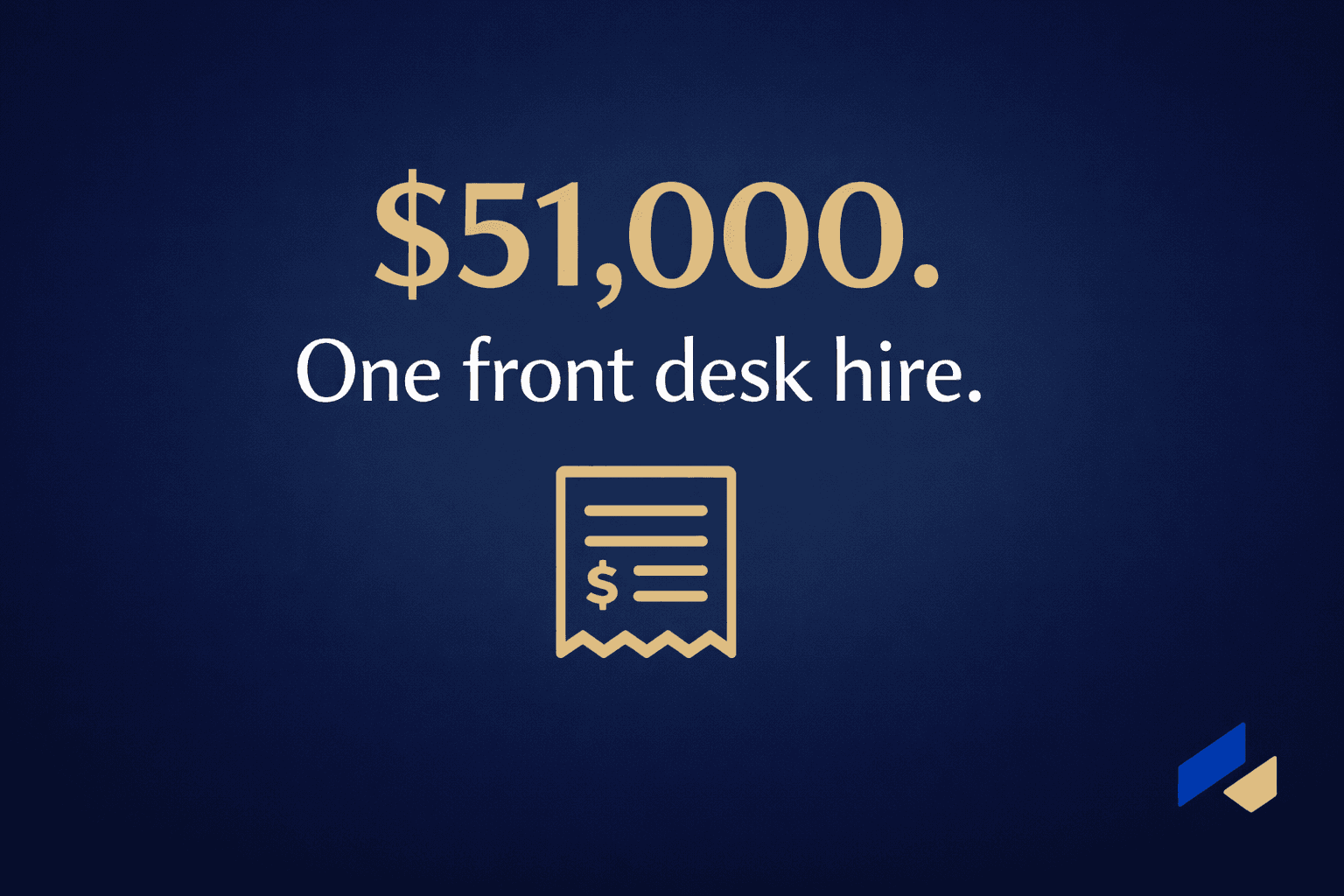
Total loaded cost range: approximately $51,000 to $55,000 per year for one full-time hire, before overtime, before a second part-timer, and before the calls they miss.
For operators wondering whether a no-show policy and deposit structure reduces the pressure on the front desk, the answer is yes, partially. Fewer last-minute cancellations means fewer scramble calls during the desk's shift. But it does not solve after-hours booking.
If your software bill is several hundred dollars a month per location, that is a line worth examining alongside this one. The math of running payroll from an appointment book only gets tighter when the desk is a fixed cost and the chair revenue is variable. Free client management software like Tersavia does not eliminate the need for front desk staff, but it does mean the software line is not compounding the hire cost every month.
FAQ
What is the total cost of a front desk employee for a spa or salon?
For a full-time hire at $18 an hour, the loaded annual cost typically runs between $47,000 and $55,000 when you include employer payroll taxes and workers' compensation. Paid time off, along with a share of recruiting and training costs, adds to that figure as well. Health insurance, if offered, adds $3,600 or more a year on top of that.
What percentage above base wages should I budget for a front desk hire?
Plan for 25 to 40 percent above gross wages to cover mandatory employer taxes and insurance, plus any benefits you offer. If turnover is high, recruiting costs can add significantly to that figure, and onboarding expenses alone may push the total closer to 50 percent over a two-year window.
Does one front desk employee cover a full operating week?
Rarely. A full-time hire covers 40 hours. Most spas and salons operate 50 to 60 hours a week across six days. Without a part-time second hire or overtime, there is at least one day per week where desk coverage depends on the owner or a service provider stepping off the floor.
What does a front desk employee not cover that software can?
Front desk staff cannot answer calls during checkout, and they leave after-hours booking requests unattended whenever sick days or holidays hit without coverage plans in place. Booking software with online scheduling and an AI phone layer can handle inbound requests outside staffed hours, which reduces the pressure on the person at the desk during the hours they are there.